Winger or Inverted Winger: Two Routes from the Flank
Winger or inverted winger: learn to distinguish their movement, foot preference and attacking lanes by tracking where each player goes across repeated possessions.
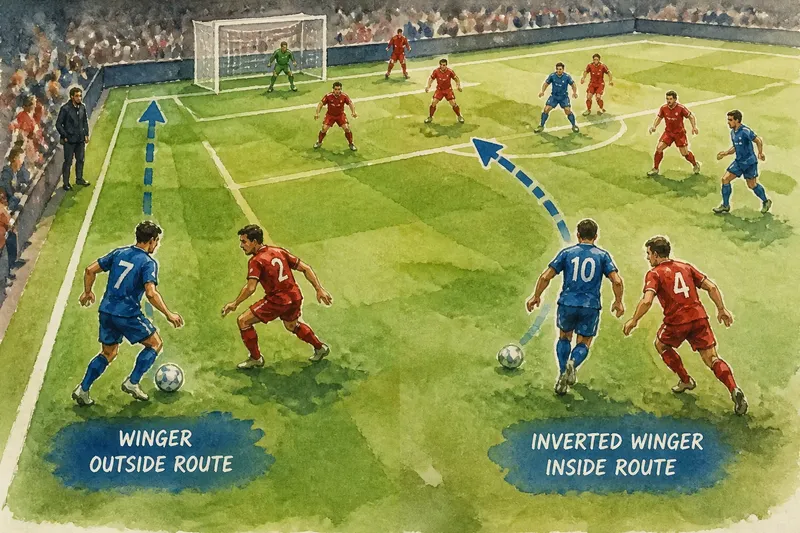
The common mistake in comparing a winger and an inverted winger is to classify the role from the player’s starting position alone. Both may begin on the same flank, but one tends to stay outside while the other moves toward the centre; miss that pattern and the next run can seem to appear from nowhere.
Two routes from wide
A winger generally holds a position near the sideline, particularly when the team has settled possession. From there, the player can receive down the line, carry forward, cross, or pass back if the route closes.
An inverted winger starts wide but often moves into an inside lane, commonly onto the foot opposite the flank. A right-footed player on the left, for instance, may carry toward the centre and look for a combination or a shot. “Inverted” describes a recurring movement and attacking angle, not an instruction to cut inside on every touch.
These are tendencies, not sealed job descriptions. A winger can move inward to escape pressure, and an inverted winger can stay outside when the central route is crowded. Look for the repeated movement across possessions rather than treating one dribble as a change of role.
The outside lane
When a winger holds the touchline, the opposing defender has to account for the space near the line as well as the route inside. If the defender moves outward, a passing lane may open behind or inside that movement. If the defender stays narrow, the winger may have room to receive and advance.
Width can also give the team an outlet when opponents crowd the middle. A switch of play may reach the winger with space ahead, allowing a carry, a cross, a short combination, or a pass back to keep possession. Crossing is one option, not the whole job.
The winger’s position can be especially useful when teammates are already occupying central lanes. It gives the attack another place to play and can draw a defender away from the middle. If the winger leaves that outside lane, the team may need another player to occupy it or accept a narrower shape.
The inside lane
An inverted winger’s movement can bring the attacker closer to the striker and central midfielders. A pass into the feet may lead to a short return, a run beyond the ball, or an attempt toward goal from a more central angle.
The defender facing that movement must judge whether to follow the attacker inward or protect the central space. Teammates may benefit from the resulting gaps, but defenders can also hand the responsibility to one another rather than chase the same player across the pitch.
Moving inside changes the attacker’s options as well as the defender’s. The player may have less room to turn, and a crowded centre can make a forward pass difficult. The role is easier to read by watching how the player receives and combines than by assuming every inward run creates an opening.
Foot and movement
Foot preference helps explain why a coach might place a player on a particular flank. A right-footed attacker on the left can receive wide and angle inward onto the stronger foot; a left-footed attacker on the right can use a similar route in the opposite direction.
That arrangement is common, but it is not the definition of an inverted winger. A player’s starting position, preferred foot, and movement should be read together. A left-footed attacker on the left may still move inside, while an opposite-footed player may be asked to hold the line.
Reading the role?
What is the difference between a winger and an inverted winger?
A winger more often holds the outside lane, while an inverted winger more often moves from the flank toward the centre. Both can vary their route, so repeated movement gives a better clue than one isolated action.
Does an inverted winger always cut inside?
No. The player may stay wide when the centre is crowded, pass backward, or change direction to meet the needs of the move. The label describes a tendency, not a compulsory turn.
Does the stronger foot decide the role?
No. An opposite-footed player may find inward carries and shots convenient, but foot preference alone does not establish the role. Watch where the player repeatedly moves after receiving the ball.
Can the role change during a match?
Yes. A coach can ask a wide attacker to hold the line more often or move inside, and the player may also vary the route as the match develops. Look for a sustained change in starting positions and movement rather than a single adjustment during one attack.
A worked match read
Say you are watching a left-sided attacker who is right-footed and receives near the sideline. Across several possessions, the player carries toward the centre while teammates occupy the outside lane. The observable pattern points to an inverted role: the attacker is repeatedly seeking the inside route, and the outside position remains available to a teammate.
Now imagine the same player staying close to the line and receiving passes facing forward, while the central attackers move into the box. That pattern points more toward a winger’s role: the player is preserving an outside option, and teammates are using the middle. Neither reading tells you the next pass; it tells you which lane the player is regularly asked to occupy. The distinction is like placing a chair by a doorway: its position affects which nearby route remains clear.
What to watch
- Observe whether the attacker repeatedly receives near the sideline; if so, read the role as more winger-like, but if the player often moves inward after receiving, consider an inverted role.
- Observe which foot the attacker uses to turn toward goal; if the turn regularly brings the stronger foot inside, note that as support for an inverted tendency, but if the player mainly advances along the line, give greater weight to the outside route.
- Observe whether the attacker’s runs end near the touchline or in an inside lane; if the runs repeatedly finish inside, read the movement as inverted, but if they preserve the outside position, read it as winger-like.
- Observe whether the player combines with teammates near the centre; if short central combinations recur, note an inside role, but if the player usually links play near the line, note an outside role.
- Observe whether the player changes direction when the central lane is crowded; if the attacker then stays wide, treat that as a situational adjustment, but if the inward movement continues across possessions, retain the inverted reading.
- Observe the same player over several attacks rather than one touch; if the route remains consistent, describe the role by that recurring pattern, but if it varies, call the role flexible instead of forcing a single label.
The search phrase “winger or inverted winger” is useful as a comparison, but the match itself supplies the answer through repeated movement. Track where the player receives, turns, and ends a run; that gives a clearer reading than the starting position alone.