The Full-Back’s Changing Place in Football
Understand the full-back role in football by spotting when a defender overlaps, moves inside or holds position, and see how each choice shapes team support.
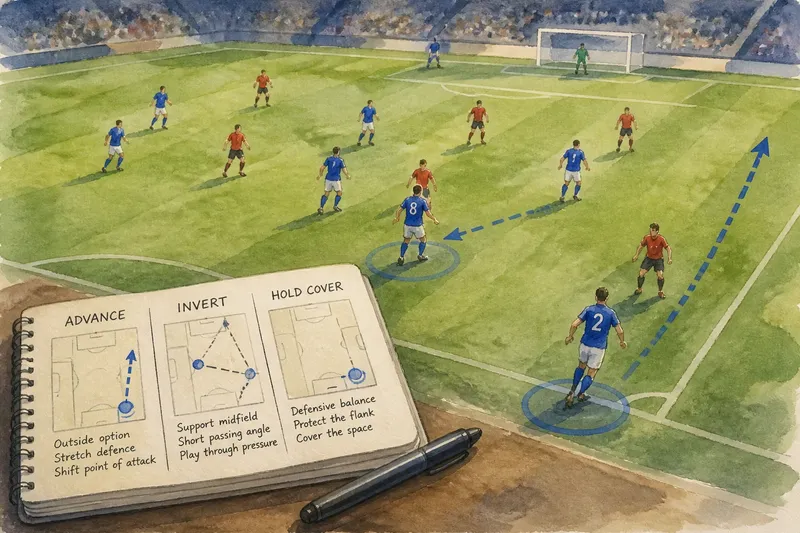
The common mistake in reading a full-back is to treat every forward run as the same event. That misses the cost: one run may stretch the defence, another may crowd midfield, and a third may leave the flank exposed if possession turns over. The full-back role in football becomes clearer when you ask what problem the player’s position is meant to solve.
Full-backs still protect the outside channel and support the central defenders, but their duties vary with the team’s shape. They may advance along the touchline, move into midfield, or stay behind the attack to protect against a counter. The position is less a fixed assignment than a set of choices made in relation to teammates.
Start with team needs
Do not begin by deciding that a full-back is “attacking” or “defensive.” Watch where the team has space and where it lacks a player. The same footballer may hold a conservative position on one side and advance on the other because the flanks serve different purposes.
Think of the full-back as a movable shelf: its value depends on what the team needs within reach. A player stationed wide can stretch the defence; one who steps into midfield can offer a short passing angle. The useful question is not simply where the player stands, but what that position allows the next teammate to do.
Provide an outside option
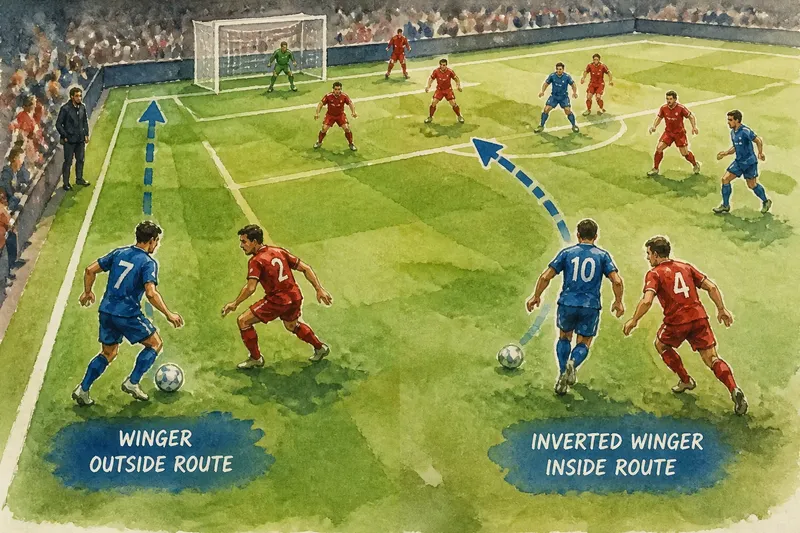
A full-back who advances along the touchline gives the team a wide outlet. The player can receive a switch of play, carry the ball into space, or offer a route around a crowded central area. A cross may follow, but it is only one possible outcome.
This movement is useful when the team needs to shift the point of attack or keep an opponent’s defensive line spread across the pitch. The full-back may also draw a defender outward, creating a different route for the ball. Watch the timing: an advance that arrives after teammates have lost control can leave the player isolated rather than available.
Support the midfield
Some full-backs move inside during possession instead of staying near the touchline. This is often called inverting. The player joins the midfield line or occupies a central pocket, providing a nearby passing option and helping the team circulate the ball through the middle.
This choice can suit a side whose wide attackers already occupy the outside lanes, or one that wants another player around the ball. Rather than running forward along the boundary, the full-back offers support at a different angle and may help the team play through pressure.
There is a trade-off: the flank may be left open. A teammate must account for it, or the opponent can attack into the space the full-back vacated. When the player moves inside, check whether a midfielder or central defender shifts across. That movement is part of the role, not housekeeping after the interesting part.
Keep defensive cover
A full-back may stay deeper while the teammate on the opposite side advances. This asymmetric arrangement gives the team an attacking runner on one flank and a defender in place on the other. It lets the team send players forward without leaving both outside channels unprotected.
A conservative position can also suit a side under pressure or facing a dangerous wide attacker. The full-back’s first task may be to preserve the defensive line, delay a dribble, and avoid being drawn too far from the central defenders. Staying back still contributes: reliable cover gives teammates more room to take risks ahead of the ball.
When the team has possession, notice whether the deeper player remains close enough to help recycle it. If the player is too far from the action, the team may lack an easy backward pass; if the player advances, the cover they were meant to provide may disappear. The position reflects the balance the team is trying to hold.
Full-back roles in practice?
Why does a full-back advance?
An advance can provide an outside passing option, carry the ball into space, or shift the opposing defence. The run’s value depends on whether teammates can use the space and whether cover remains behind it.
What does an inverted full-back do?
An inverted full-back moves into a central area during possession rather than staying wide. This adds a passing option in midfield, while a teammate must account for the open flank.
Why does only one full-back advance?
Keeping one full-back deeper can provide cover while the other joins the attack. It suits a team that wants a forward option on one side but still needs a defender positioned to respond if possession changes hands.
Can a full-back contribute without crossing?
Yes. The player can carry the ball, combine with a midfielder, occupy a central position, or draw an opponent away from a teammate. A cross is just one possible outcome of an advanced role.
Track the surrounding players
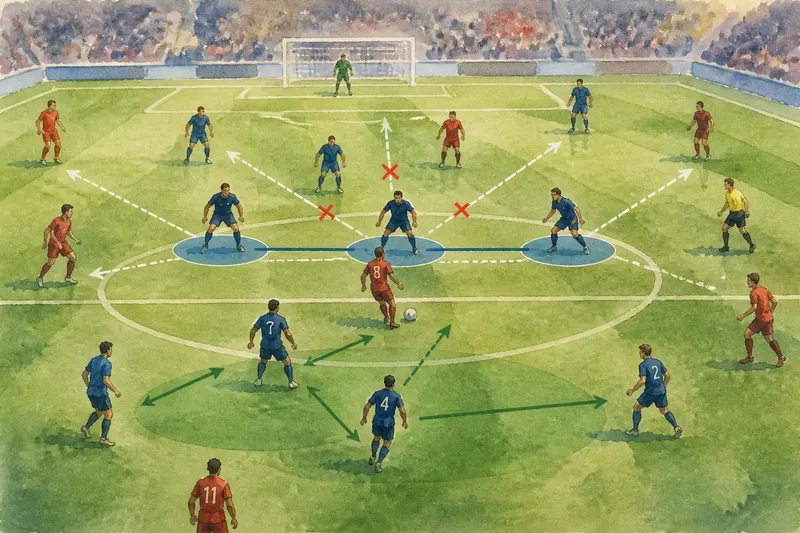
To interpret a full-back’s movement, watch what happens around it. Does a midfielder shift across, does a central defender move wider, or does a teammate stay behind the ball? Those responses reveal how the team intends to preserve its shape.
Say you are watching a team whose right full-back moves into midfield while the ball is on the left. Imagine the starting picture is a central midfielder already close to the left-sided defender and no player stationed near the right touchline. The full-back steps inside; if the right winger holds the outside lane, the team keeps a wide outlet, but if that winger also moves centrally, the opponent can find the open flank. The resulting read is straightforward: the full-back’s move adds central support only if another player keeps the outside channel available.
When possession is lost, keep watching the same player. A high full-back may press the nearest opponent, recover toward the flank, or rely on a teammate already covering behind. The response helps distinguish a planned attacking role from a forward run that has left the team without a clear shape.
The full-back role in football is best understood as a decision within the team’s structure: offer an outside route, support the middle, or preserve cover. On the next match, choose one flank and track the player’s starting position, movement in possession, and response after a turnover. That small habit makes the role’s changing place in the game easier to read.