Reading a High Defensive Line Beyond Its Risk
Learn to read a high defensive line by tracking pressure, runs, and goalkeeper positioning, so you can judge when the space behind is truly available.
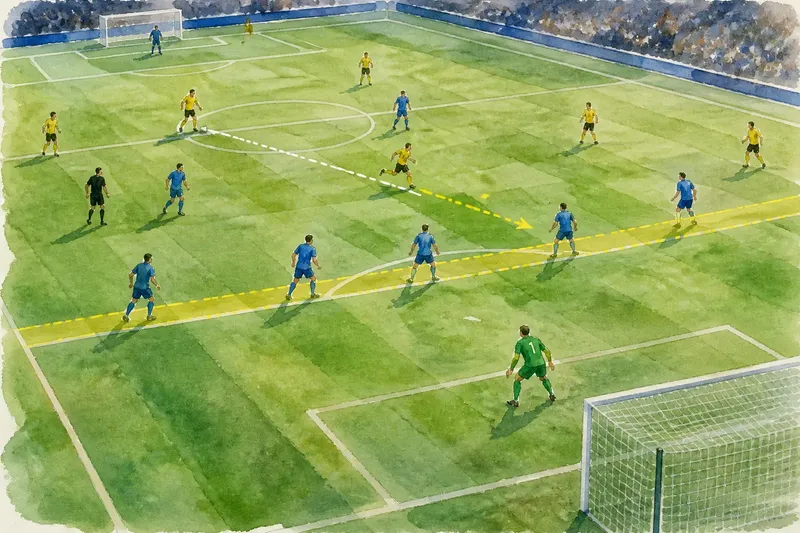
The most common mistake in reading a high defensive line is to treat the space behind it as proof of recklessness. That shortcut costs viewers the tactical point: the line may be positioned to contest the next pass, keep attackers facing away from goal, or support pressure higher up the pitch. Its risk depends on what the opponent can do with the ball, not simply on how much grass lies behind the defenders.
Read the ball first
Start with the opponent in possession. A defender’s position means little until you see whether the passer can lift their head, how the receiver is facing, and whether a forward run is beginning. Those details reveal whether the space behind the line is usable or merely visible.
A slow pass toward a centre-back, for instance, may give the defending team time to step forward. A receiver facing their own goal has fewer immediate ways to send a runner through than one who has turned and can see the full pitch. The same back line can therefore look assertive in one moment and exposed in the next.
Watch for the team’s response to the ball’s movement. Defenders may step up as a pass travels backward or sideways, then retreat when an opponent receives facing forward. This is not a simple switch; players judge the passer’s control and the runner’s movement at once.
Track runs and passing lanes
Attackers do not need an empty lane to threaten a high line. A run from an onside position can test whether defenders notice it, pass it between them, or hold their ground while the passer prepares to play forward. The line’s reaction tells you more than its starting height.
Look at the passer and the runner together. If the passer has time to shape a long ball while a forward accelerates behind the nearest defender, the back line must turn and race toward its own goal. If the passer is rushed or the run begins too early, defenders may be able to step forward or challenge for the ball.
The offside rule may help a team defend high, but a high line is not automatically an offside trap. Defenders can hold an advanced position to contest clearances and keep the play away from their goal without trying to catch a runner offside on every attack. To read an attempted trap, watch whether the defenders move together as the passer prepares to play, not just whether they stand close to halfway.
Account for the goalkeeper
A goalkeeper can change how much of the space behind the defenders is genuinely open. When positioned outside the penalty area, the goalkeeper may be able to reach a long pass before an attacker does. That coverage is conditional: a chipped ball, a poor starting position, or a hesitant decision can still leave the defence in trouble.
Notice the goalkeeper’s position as the ball moves, then watch whether they advance when the passer shapes to play forward. The defender’s line and the goalkeeper’s readiness are linked. A high line without a goalkeeper prepared to cover depth asks the defenders to solve every long pass themselves.
Width creates another complication. If the ball is near a touchline, the defending team may narrow its shape to protect the centre, leaving a switch of play to test the far side. The question is not whether the whole pitch is covered; it is whether defenders can shift before the opponent exploits the open side.
Spot the warning signs
These cues help distinguish a controlled high line from one that is being tested. Each calls for a specific judgment rather than a verdict based on distance alone.
- Passer has time to look up: if an opponent can choose a long ball without pressure, expect the defenders to retreat or prepare to turn; if the passer is hurried, watch for the line to step forward and contest the delivery.
- Runner starts behind the defenders: if the attacker begins a timed run as the passer prepares to play, watch whether a defender tracks them; if the run starts too early, the line may step up and leave the attacker offside.
- Goalkeeper stays deep: if the goalkeeper remains near the goal while defenders are high, expect the back line to protect depth more cautiously; if the goalkeeper advances, watch whether they can cover a ball behind.
- Defenders move at different times: if one steps forward while another holds deep, look for a lane between them; if they advance together, check whether an attacker has been left onside elsewhere.
- Ball travels toward a sideline: if the defending side shifts toward it, expect the far side to become the next test; if the opponent switches play quickly, watch whether defenders can recover across the pitch.
- First challenge produces a loose ball: if teammates fail to move up behind the challenge, an opponent may collect the ball in front of the defence; if the line follows together, the loose ball is more likely to meet pressure.
Why does a high line fail?
What makes a high line vulnerable?
A passer with time and a runner moving at the right moment can turn the space behind the defenders into a direct route toward goal. The danger grows when the goalkeeper stays deep or defenders react at different times.
Does a high line always use an offside trap?
No. A team may defend high to contest loose balls and keep the action farther from its goal, without deliberately stepping forward to catch attackers offside on each pass. The line’s timing still matters, but its purpose can be broader than trapping runners.
What should viewers watch first?
Check whether the player on the ball can look up, then follow the nearest forward run and the goalkeeper’s position. Those cues show whether the defenders have time and support to hold their ground.
Follow one sequence
Say you are watching a team with its defenders near halfway. An opposing centre-back receives a slow pass, while a forward waits beyond the back line and the goalkeeper stands near the edge of the penalty area. The nearest defending forward closes the centre-back, a midfielder blocks the pass into the middle, and the goalkeeper moves forward as the defenders step up together. The expected result is fewer easy passing options and a smaller target behind the line; if the centre-back still has time to play long, the goalkeeper and defenders must turn and recover instead.
This sequence shows why a high defensive line cannot be judged from its height alone. Follow the passer, the runner, the defenders’ movement, and the goalkeeper in that order; the space behind matters only when the attack has the time and control to reach it.