How a Midfield Line Closes Space and Supports Attacks
Learn how a midfield line closes passing lanes and supports the first pass after a recovery, making defensive shifts and the next attacking option easier to read.
The common mistake when reading a midfield line is to track each player as if defending were a set of private errands. That makes coordinated movement look aimless, and it obscures the cost: an opponent may receive in the space the group meant to protect. To understand how a midfield line works, watch the options it removes and the support it creates after a recovery.
Shape and responsibility
A midfield line is the group of players positioned between defence and attack. It might consist of a holding midfielder and two central midfielders, or a different arrangement; its defining feature is how players share responsibility for blocking routes through the middle.
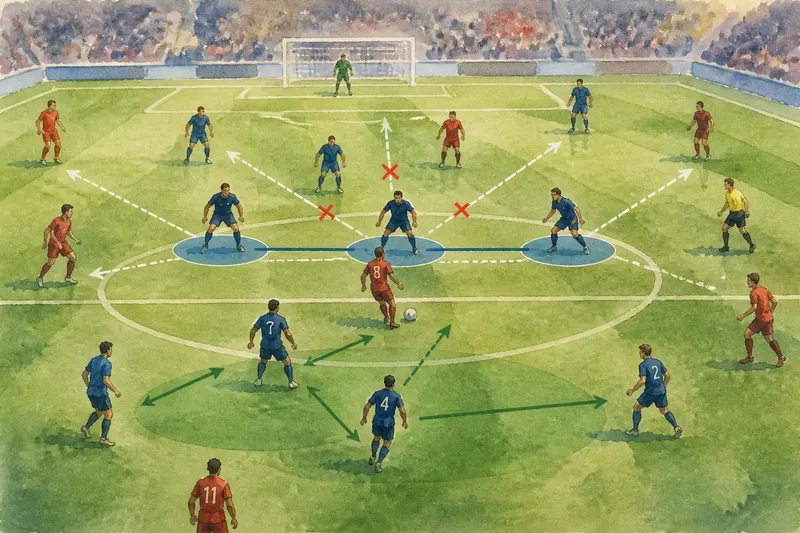
Each midfielder judges position in relation to the ball, potential receivers, and nearby teammates. A player can stand between the ball carrier and a forward, angling the body to discourage a pass into the forward’s feet. Teammates shift to cover other lanes, so that one player’s move does not expose the entire area.
The line generally moves sideways together, keeping players close enough to support one another without all crowding the ball. If everyone chases the carrier, a simple pass can take the group out of play. Instead, the midfielders narrow the most dangerous routes while staying connected.
Choosing what to leave
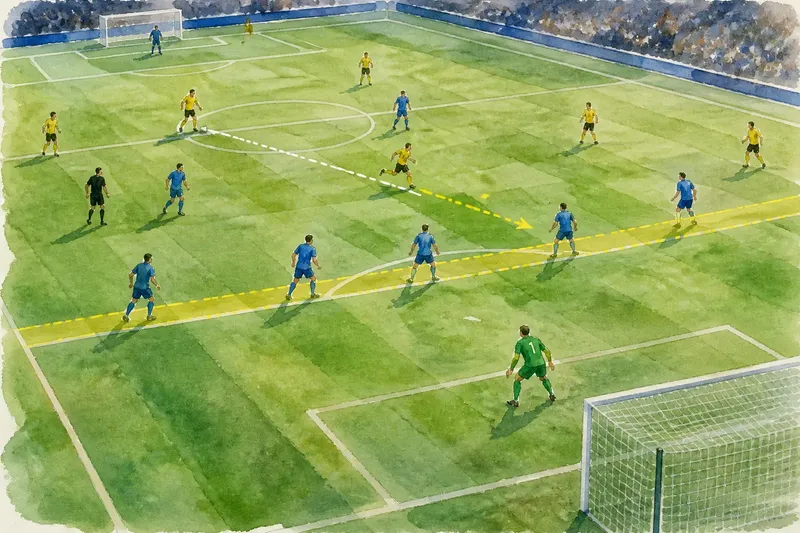
A team cannot close every passing option at once. The line may allow a pass to a receiver facing away from goal or near the touchline, where the next action is easier to anticipate. Nearby midfielders can then limit that receiver’s choices.
Watch what the receiver can do after the ball arrives. If the player must turn toward the sideline, pass backward, or take a hurried touch, the line has restricted useful options even though it did not stop the pass. The receiver’s next action often says more than the pass itself.
Support after recovery
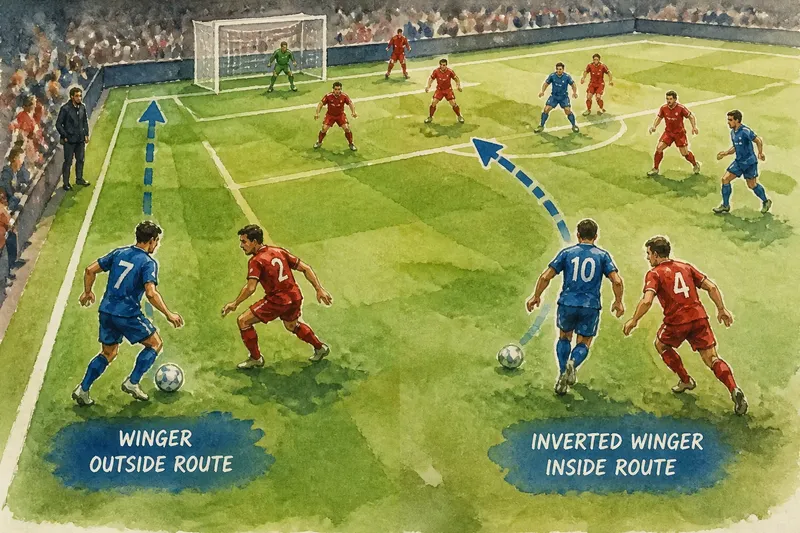
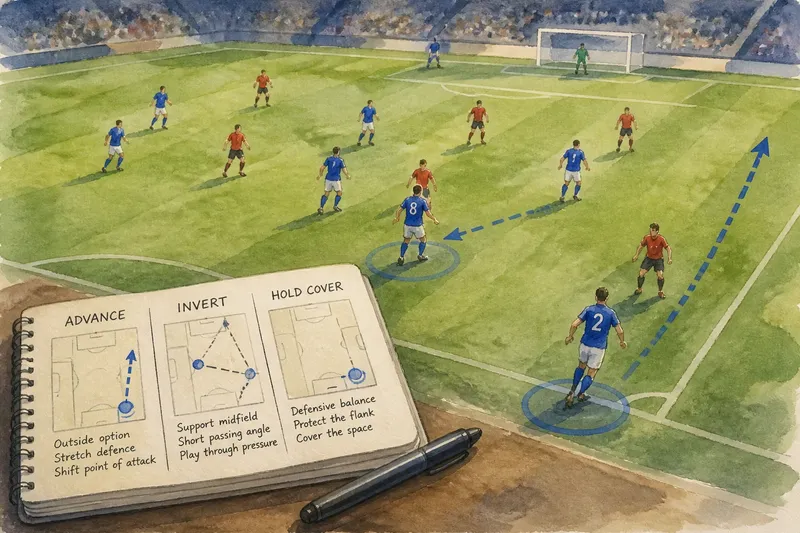
When a midfielder wins the ball, the immediate task changes. The team must create usable passing options before the opponent rebuilds its shape. Teammates move away from the crowded recovery area, but not all in the same direction: one may move forward, another stay behind the ball, and a third angle outward as a safer outlet.
A forward pass is available when a teammate finds space beyond the opponents closing on the ball, and the lane is clear enough to reach that teammate. If pressure blocks it, a sideways or backward pass can preserve possession and give the team time to find another route.
Say a central midfielder intercepts a pass as an opponent moves toward the ball. A teammate steps into the space beyond that opponent, while another remains close as a return option. The interceptor can pass forward if the lane stays open or play to the nearby teammate if pressure arrives; the observable result is a choice between a riskier advance and a safer outlet, rather than a forced single pass.
Reading the shift
Start with the midfielder nearest the ball, then widen your view to the teammates on either side. The nearest player often sets the shift by closing a lane or stepping toward a receiver. The others show whether the group is responding: they should adjust to cover the spaces that first movement leaves open.
Then check the neighboring lines. A defender may step forward as the midfield moves up, limiting the space between defence and midfield. Forwards may angle their pressure to steer play toward one side. These movements support the midfield’s work, but the main question remains whether its players stay close enough to cover one another.
A line is stretched when its players are too far apart to provide cover, or split when an opponent receives in the space between midfield and defence. It can also lose its shape when one midfielder presses alone and the others do not shift with that player. Watch the next pass: an opponent turning forward or finding a teammate in a pocket can reveal the gap.
A single frame can mislead. A midfielder may appear out of position just after the ball changes direction, while teammates are still moving across. Follow the next action and see whether the group closes the new lane together or leaves one player to defend it alone.
What viewers ask?
Does the line always move toward the ball?
No. The midfielders shift toward the ball when that helps protect dangerous routes, but they must also cover players and space on the far side. If everyone follows the ball, an opponent may switch play into open ground.
Is a forward pass always best after a recovery?
No. A forward pass is useful only if it can reach a teammate without exposing the team to an immediate turnover. A sideways or backward pass may be the better choice while teammates spread into support positions.
Why does the line sometimes retreat?
It may drop to protect the space behind the midfielders when an opponent has time to pass or run forward. The group can retreat together and remain compact, making it harder to play cleanly through the middle.
How can I tell whether the shift worked?
Look at the opponent’s next available action, not simply how far the midfielders moved. A forced sideways or backward pass suggests the line has reduced useful options; after a recovery, check whether teammates offer the ball carrier more than one sensible pass.
Timing and cues
The same movement can help or hurt depending on when it happens. Step forward too early and a pass may reach a player behind the line; wait too long and the receiver may turn. Teams respond to cues such as a heavy touch, a pass traveling toward the sideline, or a teammate closing down the receiver.
To read how a midfield line works, track its position before the pass, its response as the ball travels, and its support after a recovery. A teammate’s movement matters because of the lane it closes or the next pass it makes possible, not because the player has simply covered ground.
One plain way to judge the shift is to ask what changed for the opponent: which route became difficult, which route remained available, and whether the receiver could act facing forward. Those questions keep attention on the tactical consequence rather than on movement for its own sake.