A Match-Watching Notebook for Tracking Transitions
A match-watching notebook for tracking transitions helps you capture turnovers clearly, separate visible actions from interpretation, and compare team responses later.
The common mistake in a match-watching notebook for tracking transitions is trying to record every possession change. That leaves you writing through the moment instead of seeing it. A few precise entries are more useful than a full transcript of events.
A transition begins when a team wins or loses the ball. For a notebook, the useful question is narrower: what changed immediately, and what can you actually see? Record the event, the first observable response, and the result. Leave motives for later.
A Compact Entry
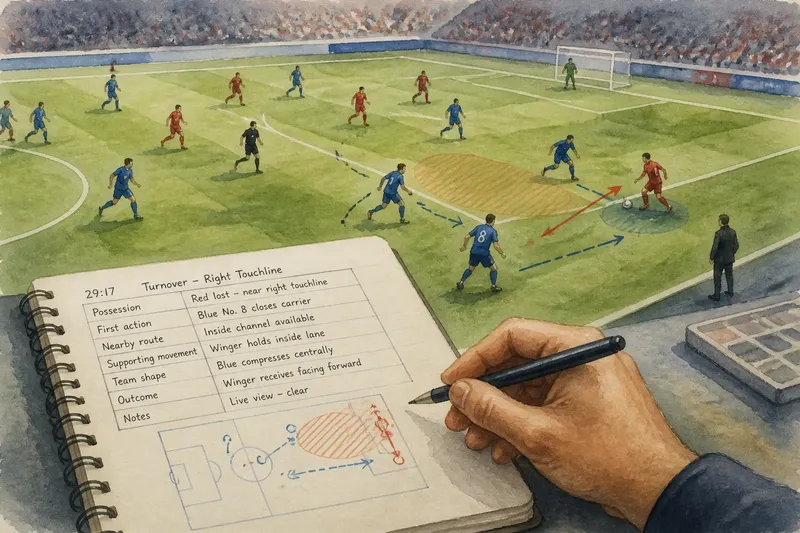
Use a notebook page or a simple spreadsheet with one row per selected moment. Add the match time or a short sequence label so you can find the scene again. Keep the language concrete: “No. 8 turns toward the carrier” is easier to revisit than “midfield intensity rises.”
For each entry, check these details and make the corresponding decision:
- Possession change: Check which team gained or lost the ball and where; if the location is clear, record it, otherwise mark it as uncertain and do not infer a lane.
- First action: Check who moved first and in which direction; if the player is identifiable, name the role or number, otherwise record “player near ball.”
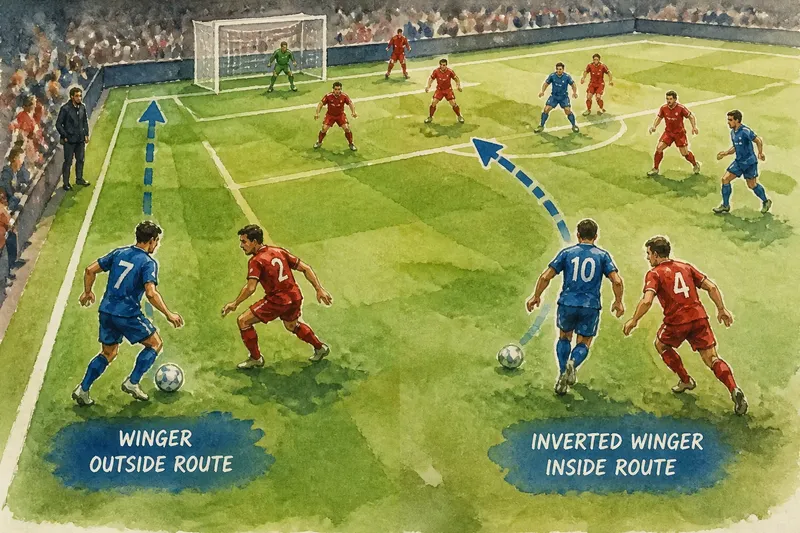
- Nearby route: Check for a visible passing lane or open area; if one is clearly available, note its location, otherwise write “no clear route” rather than inventing one.
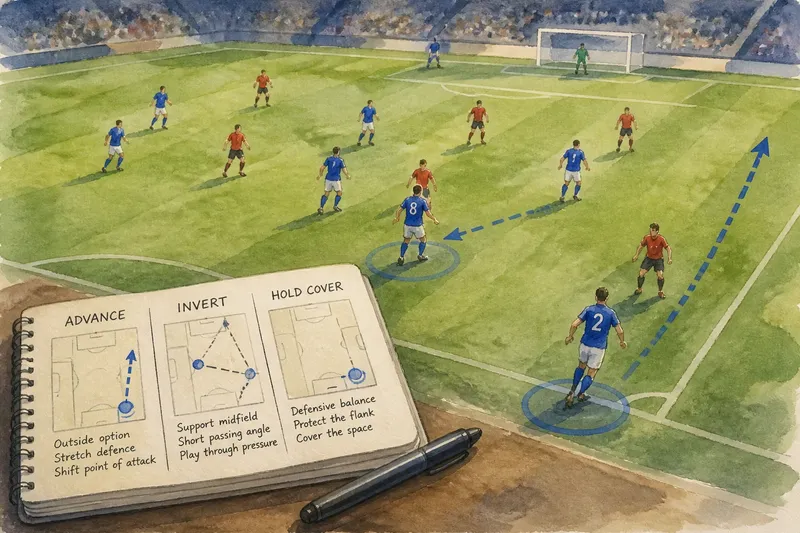
- Supporting movement: Check whether nearby teammates press, cover, or recover; if their movement is visible, record the action, otherwise leave this field blank.
- Team shape: Check whether players remain spread out or move into a more compact arrangement; if the change is visible, describe it, otherwise wait for a clearer moment.
- Outcome: Check whether the next action keeps possession, moves the ball forward, ends in a clearance, or leads to another turnover; if the sequence is obscured, mark the outcome uncertain.
Think of the page as a map with only the streets you need marked. Adding every road does not make the next turn easier to spot.
Separate Seeing From Guessing
Describe visible actions before assigning a tactical purpose. “Striker curves toward the center-back” records movement; “striker blocks the pass to the center-back” adds an interpretation. Keep both if useful, but mark the second as tentative.
A player can press and still be bypassed, while a teammate may recover the ball elsewhere. Note the action and then the consequence rather than allowing the outcome to rewrite what came before. That small distinction keeps a notebook from becoming a confident story about intentions no camera can show.
Record Space and Shape
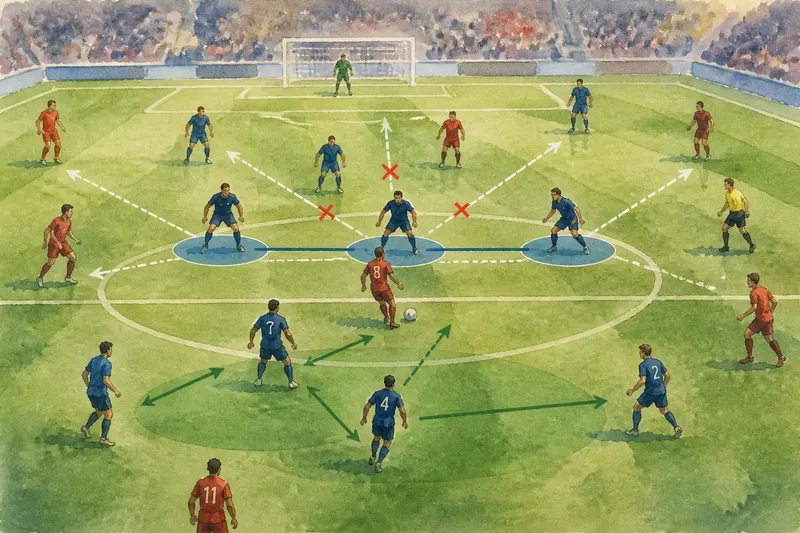
Describe space in familiar football terms: the inside channel, the touchline, the area behind the nearest presser, or the space in front of the center-backs. The nearest useful opening is not always the largest patch of grass. It is the route a player could plausibly reach with a pass, carry, or run.
Shape takes longer to emerge than a first reaction. Note whether nearby players protect the center or chase toward the sideline, whether a defender steps forward with cover behind, and whether wide players recover or remain high. Avoid naming a settled formation from a brief, shifting scene.
Imagine a team loses the ball beside the right touchline. The starting inputs are visible: a midfielder is close to the new carrier, an opposing winger is in the inside channel, and the broadcast view shows both. Record the first action as “midfielder closes carrier,” the available route as “inside channel,” and the next event as “winger receives facing forward.” The resulting entry distinguishes what happened from any claim about why the midfielder moved; if the winger had not received, the note would still describe the same starting picture accurately.
Reviewing Entries?
How many transitions should I record?
Choose a small set of clear moments from different parts of the pitch and include both teams where possible. If a moment is hard to see, skip it rather than filling the page with guesses.
Should I follow one player?
Start with the player closest to the ball, then note nearby support if it is visible. If one role repeatedly appears in your selected moments, track that role for a few sequences while keeping the team context in view.
What should I do with a replay?
Keep the live-view note and add a separate correction if the replay reveals a missed touch or off-screen movement. If the replay does not clarify the detail, retain the uncertainty instead of replacing it with a guess.
How can I compare teams fairly?
Use the same prompts for both sides and compare similar situations, such as a turnover near a touchline. If the locations or circumstances differ, keep the entries separate rather than treating them as equivalent.
Find Patterns Carefully
After the match, group entries by location or type of change. A team may repeatedly close down quickly after losing the ball on a flank, or direct its first pass toward a forward in the center. Treat a recurring observation as a question for another viewing, not a permanent label.
Keep the observation and interpretation distinct. “Left-back steps forward; winger stays wide” is visible evidence. “The team is trying to trap the ball on that side” is a possible reading. If later entries do not support that reading, revise it without changing the original observations.
A match-watching notebook for tracking transitions is most useful when it tells you where to look next. Short entries preserve the shape of the moment; careful uncertainty preserves your ability to learn from it.